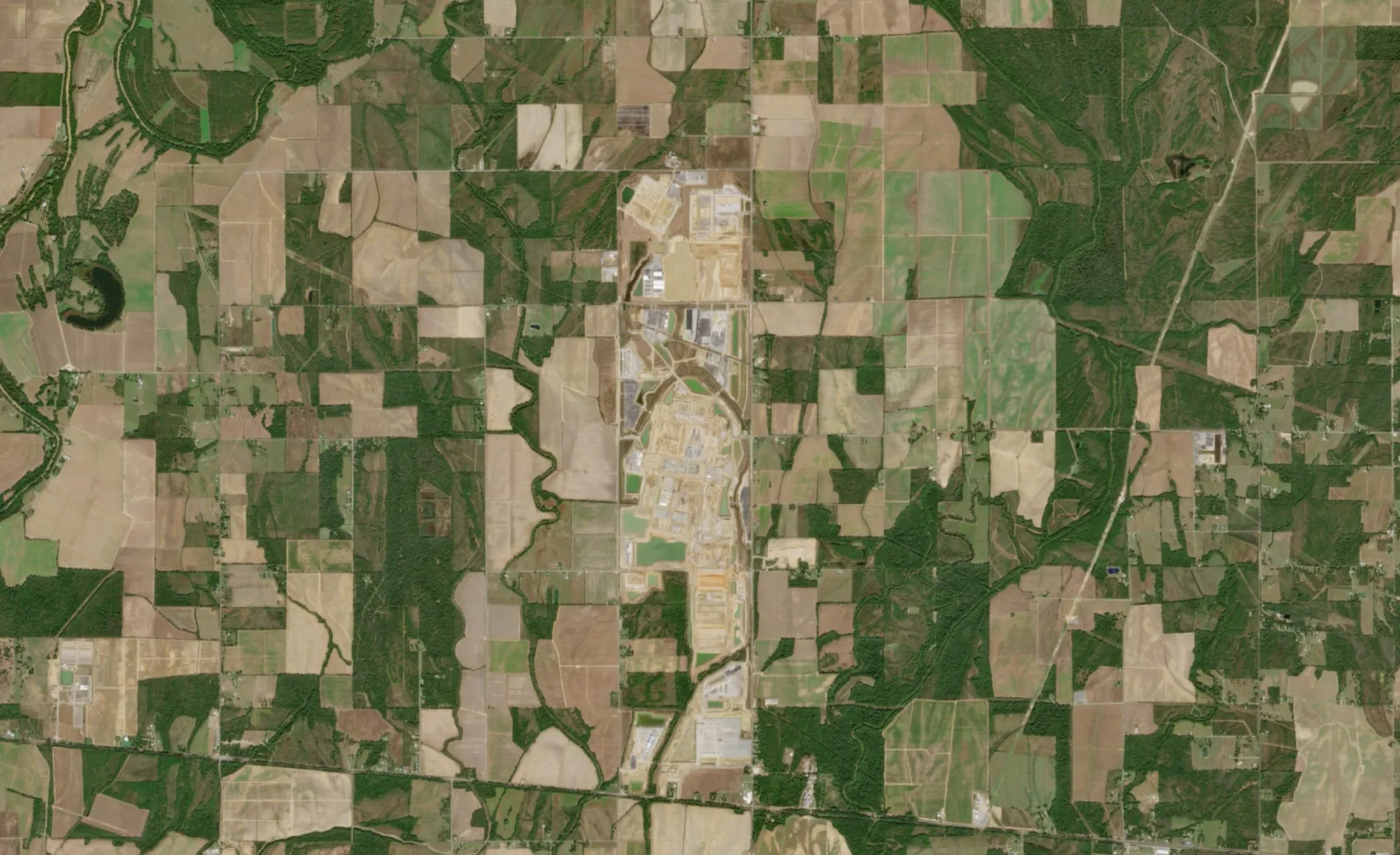
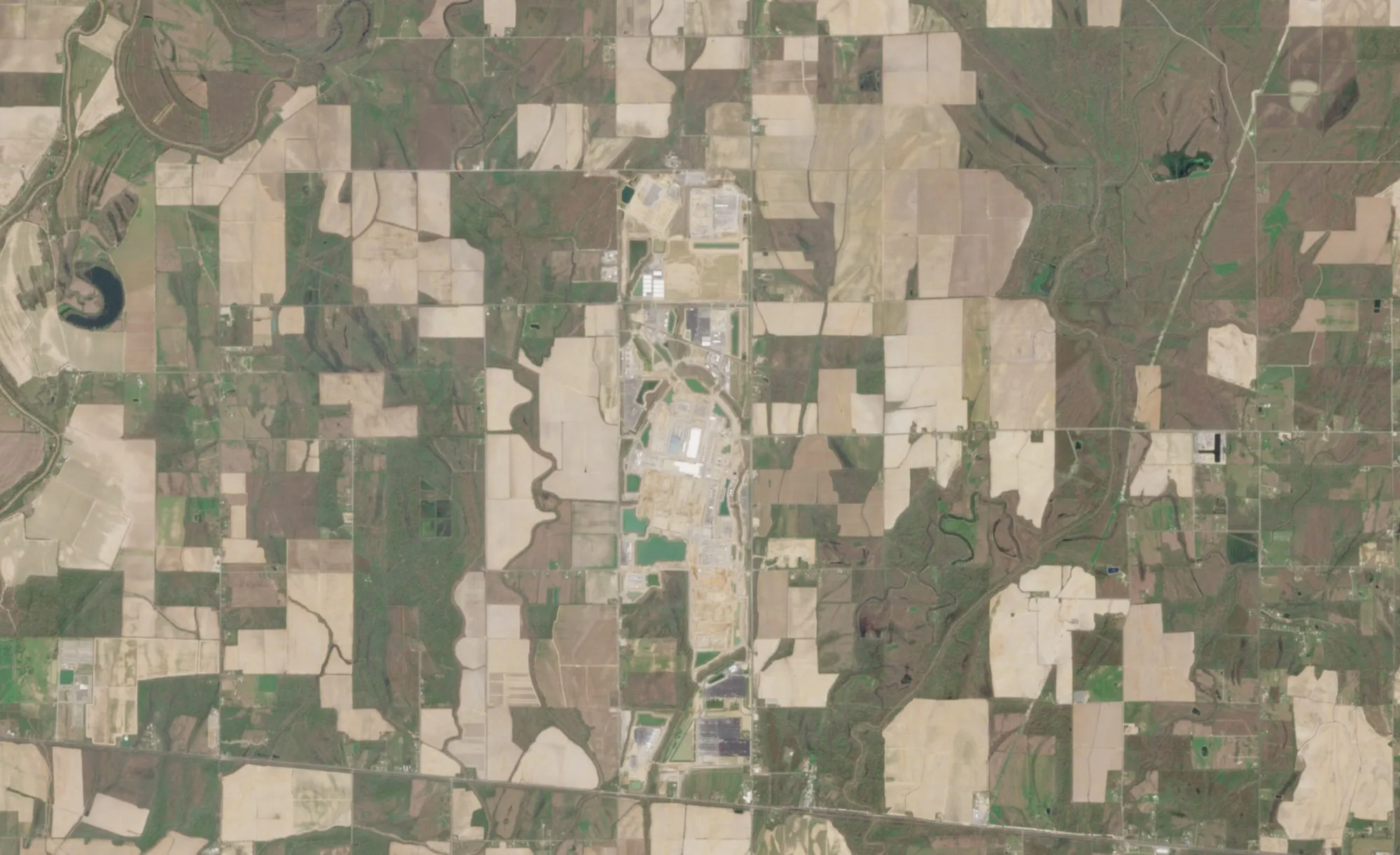
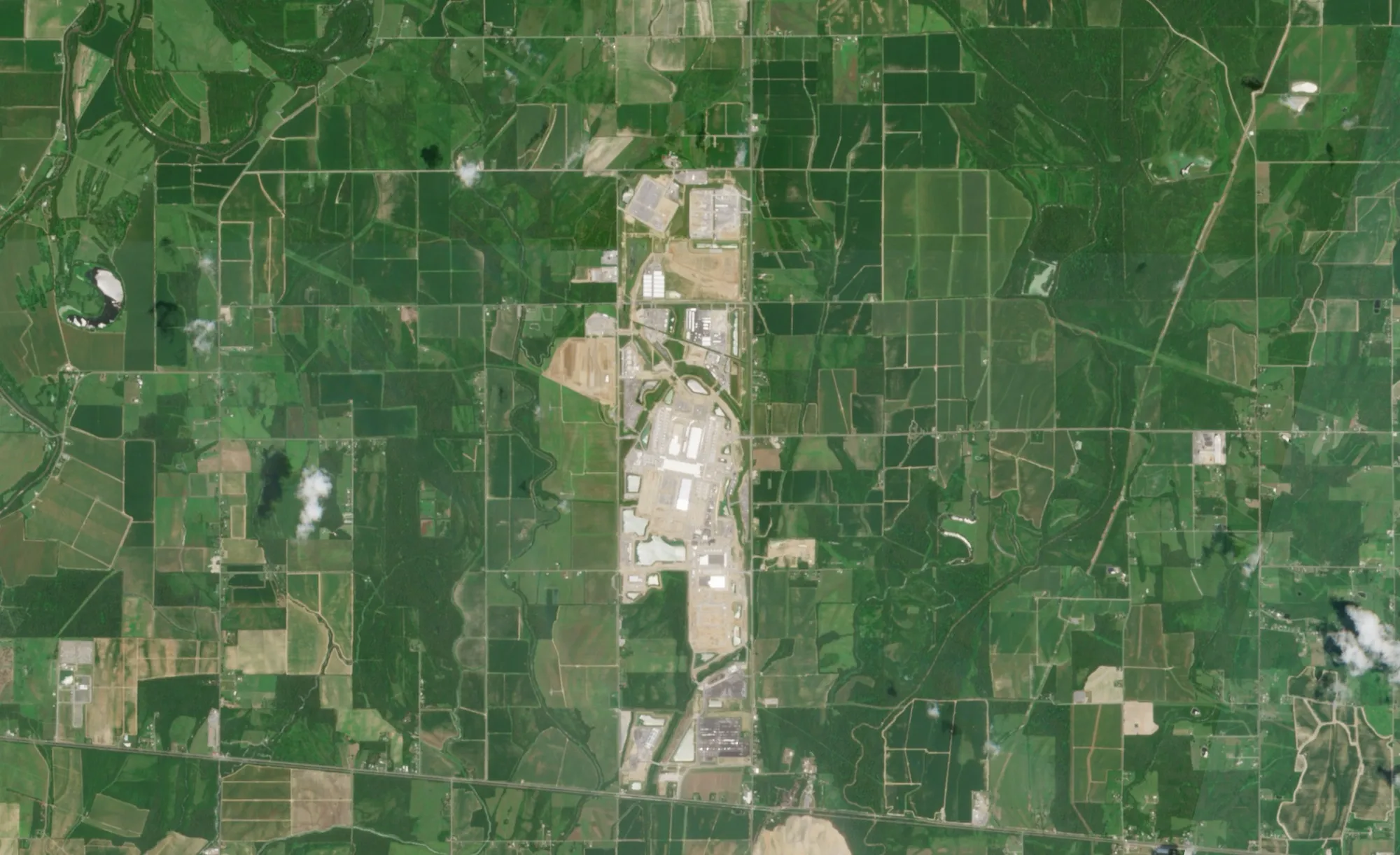

Roofs on, power still to come
Most of Hyperion’s main halls now have roofs. The gas plant Entergy is building to power them is not due until late 2028.
Sources: Copernicus Sentinel-2 imagery; Entergy LouisianaEar Tothe Ground
Anthropic goes public on Nov 19th with about $901bn committed to computing capacity. In the days before the IPO, we asked the people building America’s data centres when that capacity will be delivered, if at all.
Hyperion campus, Richland Parish, Louisiana, one image about every four months from 5 November 2025 to 10 November 2026. Sentinel-2, true colour, cropped. Contains modified Copernicus Sentinel data 2025–26, processed in Copernicus Browser. Callouts are LATO’s reading of the images, informed by press reports and Entergy and FAA filings.
In the days after the midterm elections and the resignation of Jensen Huang from Nvidia, and before Anthropic’s IPO, we interviewed 29 people who build, power, supply, and finance America’s AI data centres. This is their account of what is slowing the work and what has changed.
An eventful November
Voters in ten states favoured limits on data centre development in 40 of the 41 local ballot measures put to them1, and Texas elected a governor who had campaigned on a moratorium.
Jensen Huang resigned as chief executive of Nvidia, the company whose chips most of these buildings are designed to house and which had become a source of financial support for some of its customers.
Anthropic, one of the largest buyers of computing capacity, priced its initial public offering at $83 a share, above the $70 to $78 range it had set2, valuing the company at about $1.5 trillion3. It has disclosed about $901bn of future payments it has committed to make, almost all of it to buy or lease computing capacity and the data centres that house it, with about half falling due before the end of 20304.
Between November 13th and 17th, we spoke to 29 people who work on these projects: construction managers, utility engineers, equipment suppliers, land and permitting specialists, developers, and lenders. We asked each of them what has been causing delays on their projects before November, what has happened in the wake of these November events, and how they expect the buildout to evolve in 2027 and beyond.
What we heard
Well before November, projects were already being held up, most often by the wait for grid power.
Well before November, projects were already being held up, most often by the wait for grid power.
The equipment needed to deliver it is in short supply too: a large transformer now takes two years or more to arrive.
Most of what is already being built will be finished, typically some months late.
Most of what is already being built will be finished, typically some months late.
The capacity at risk is that which has been announced but not started, of which most of the people who gave a figure expect between 20% and 50% never to be built.
As expected, the Texas freeze has fallen hardest on projects still waiting in the queue.
As expected, the Texas freeze has fallen hardest on projects still waiting in the queue.
Within weeks, however, it had also brought a large campus, which had most of its permits and was already under construction, to a pause.
Some customers have started looking at sites in other states.
Some customers have started looking at sites in other states.
Within days of the election, one developer had enquiries for about 2.6 GW of capacity outside Texas, although little has actually moved and most people said it was too early to tell.
Nobody we spoke to has seen anything change on their own projects since Jensen Huang’s departure from Nvidia.
Nobody we spoke to has seen anything change on their own projects since Jensen Huang’s departure from Nvidia.
For newer AI cloud companies, however, borrowing had been getting harder for about a year before Huang left.
Delays, delays, delays
Some time before November, ground was broken on a site in Northern California for a hyperscaler’s data centre campus. The utility had told the developers that the transformers needed to connect the campus would be available in 24 months. Once work started, the estimate became “10 years, if at all”, according to a manager at the generator maker supplying the site. Left with no alternative, the customer ordered gas engines to run the campus itself, at roughly three times the unit cost of the diesel backup sets it had first asked for.
Few delays are as severe as this one, but most have the same causes. Well before the turmoil of November, everyday constraints of power, equipment, and labour were already holding projects up. Of the 26 people who told us about delays on their projects before anything happened in November, 14 cited grid power. Permitting and policy holds came next, cited by 12, followed by construction problems (9), late electrical equipment (9), and labour (3).
Grid power was the cause of delay cited most often
Number of people citing each cause of delay before November 2026, of 26 who answered
People could cite more than one cause, so the bars sum to more than the number who answered.
Source: LATO interviews conducted November 13th to 16th, 2026. Platform coding of 26 of the 28 interviewees, generated November 16th. People could cite several causes.
The grid operators’ own forecasts show the scale of the demand. PJM, which runs the grid across 13 states including Virginia, expects data centres and other large users to add 35 GW to its peak demand between 2026 and 2031, slightly more than its entire forecast growth.5
Sites that were already well underway measured delay in a matter of months: a planner at a Midwest utility, who has connected about twenty data centres, indicated that the average delay was around 2 months. For sites yet to be built, however, delays were more often counted in years: a land and permitting consultant with seven early-stage projects in Texas put the typical delay at about a year, and had seen some slip by two.
Building their own power
How does one get around a slow grid connection?
The answer, among the people we spoke to, seems to be to stop waiting for the grid. One senior executive at a power contractor told us that, at the start of 2026, projects generating their own electricity made up only about 10% of the proposals reaching his firm. By mid-August, the share was about 40%, and he expects it to reach 60% early next year. An electrical engineer in Texas said every large campus in his portfolio is now designed to generate its own power, with the grid supplying only what is needed for construction. Similar strategies are now being considered at almost every site in Northern Virginia, according to a former development manager there. A permitting consultant who works across Texas and the Southeast put the share of his clients now considering it at 30 to 50%.
At one power contractor, projects generating their own power went from 10% of proposals to 40% in 2026
Approximate share of the proposals reaching his firm in which the project generates its own electricity
Source: LATO interview conducted November 13th, 2026, with a senior executive at a power contractor in the central United States.
Developers are looking beyond the grid because the date a utility gives for delivering power tends to be pushed back between the first feasibility estimate and the signing of a contract. The head of site selection at a colocation operator, with a large pipeline of sites in the United States, said every one of his projects had been given a later date when the utility went from a feasibility estimate to a signed agreement. “They’re all just adding one to two years on,” he said. His sites were running 18 to 24 months behind for a full high-voltage connection and opening on smaller supplies in the meantime. In Northern Virginia, a construction manager described two buildings of 40 MW each, with their equipment installed, that waited almost four months for power while his crews heated and dehumidified the rooms to protect equipment nobody could switch on.
They’re all just adding one to two years on.Head of site selection, colocation operator, United States
Generating on site brings issues of its own. Large gas turbines, a developer’s procurement lead said, cannot now be had before about 2030. GE Vernova, one of the three large manufacturers, reported 122 GW of gas turbine orders and reservations at the end of September, about six years of output at its target rate of 20 GW a year.6 The plants need an air permit and a gas supply. Estimates of the whole route, from a standing start to first power, ran from 18 to 24 months where gas is close by and engines can be used, to 42 to 48 months where turbines are needed, which one engineer put at six months to a year longer than a grid connection. There is also considerable cost to going down this route: one colocation executive said it makes economic sense only where the grid is eight or more years away.
The equipment queue
Whichever route a developer takes, the grid or its own generation, it needs the same electrical equipment to distribute the power: transformers, switchgear, and breakers. All three are in short supply. Wood Mackenzie, a consultancy that surveys the market, put the wait for the transformers that connect a power plant to the grid at more than 160 weeks in early 2026, up from 143 weeks in 2024.7 With waits this long, some buyers no longer wait for a schedule before they order. An equipment supplier’s sales executive estimated that 20 to 30% of the orders he sees are placed early to hold a place in the factory queue, before the project has a firm construction date.
A data centre site seen from above
Hyperion’s main block in Louisiana, November 2026

Hyperion campus, Richland Parish, Louisiana, 10 November 2026. Sentinel-2, true colour, cropped. Contains modified Copernicus Sentinel data 2026, processed in Copernicus Browser. Labels are LATO’s reading of the image; switchgear sits inside the buildings, and Entergy’s gas plant is about 5 km north, off this picture.
How the parts fit together
A simplified view of one site. The equipment in short supply is drawn in orange. Not to scale.
Six of the twelve people we spoke to who buy, install, or make this equipment said lead times had lengthened during 2026. On the other hand, four said it depended on the item, one saw no change, and one, at a large developer in Texas, had seen a quote for generators come down to 56 to 60 weeks, almost a year less than the time he had budgeted for.
Lead times stretched between 2020 and 2024, and have not eased since
Lead time from order to delivery, in months
Sources: November 2026, LATO interviews conducted November 13th to 16th. 2024, Wood Mackenzie via NIAC, Linesight, and industry reports. 2020, Reuters, Mitsubishi Power, Stream Data Centers, and trade guides (1, 2, 3). The three transformer rows share one published figure for each of 2020 and 2024. A missing bar means no published figure was found. One equipment supplier gave a shorter range for large transformers, of 50 to 100 weeks or more; the bars show quotes on specific units.
The bottleneck appears to be further up the supply chain. One sales director at a switchgear manufacturer we spoke to said that factories in his industry have capacity to spare. What they lack are the medium-voltage breakers needed for every order, which he said take 42 to 50 weeks to arrive, as well as the engineers needed to design each one, a job taking 15 to 18 weeks.
He described a wave of newer manufacturers, some backed by private equity or venture capital and others spun out of larger firms, all drawn by what he called the data centre gold rush. By his estimate, they now win about a quarter of the bids he sees, typically by promising delivery in under a year where established makers quote thirteen months. The difficulty is that they buy their breakers from the same few firms as everyone else, among them Square D (a Schneider Electric brand), Siemens, and ABB. Those firms, he said, will not release breakers to a rival when they need them for their own projects. He expects orders placed with the newcomers to arrive three to six months later than promised.
“It’s easy to put up the concrete,” he said. “It’s hard to get in the electricals.”
It’s easy to put up the concrete. It’s hard to get in the electricals.Sales director, switchgear maker, United States
Deadlines missed, tenants staying
All of this was resulting in missed dates well before November. When asked about the share of projects they’d seen miss a contractual milestone in 2026, seven of the eleven people who gave a figure said they’d seen this on at least a quarter of their projects; five of them had seen it on half or more.
“When are they not missed?” a land originator joked.
Despite the delays, tenants have mostly stayed. The date is waived, a new one is agreed, and penalties apply only after that. None of the people we spoke to have seen missed deadlines lead to the termination of an agreement yet.
These delays come on top of schedules that are already long. Asked how long it takes to bring a site of about 100 MW from first request to power, six of the nine people whose answers could be compared said two years or more. For sites of 500 MW or more, three of seven said more than three years, and one of those said five to seven.
Most said it takes two years or more to get power to a 100 MW site
Time from first request to power, as each person estimated it. A bar runs from the shortest to the longest time they gave.
Six of the nine people whose answers could be compared said two years or more (right of the dashed line).
For comparison: generating power on site, from a standing start to first power
Three of seven said more than three years (right of the dashed line), and one of those said five to seven.
For comparison: generating power on site, from a standing start to first power
Source: LATO interviews conducted November 13th to 17th, 2026.
The operators of these sites are seldom in a hurry either. The head of site selection at a colocation operator said that, for his company, a delay of one to two years rarely damages the economics of a project. Occasionally, it might even improve them if the delayed site opens into a market with scarcer capacity and more premium rents. Beyond two years, however, the cost of carrying an unfinished site begins to weigh on returns, and an operator may then consider abandoning the project or persuading the customer to take space elsewhere in its portfolio.
There are some notable public cases of patience running out. In October, Microsoft ended its contract for Nscale’s planned site at Loughton in Essex after the power connection was delayed. It is to be seen whether Anthropic will do the same with Lambda. Anthropic’s amended prospectus of November 10th says their $34.9bn agreement became terminable after Lambda, an AI cloud company, failed to secure the lease on a site by the agreed date. Neither side had given notice of termination by that date, and Anthropic has said it does not currently intend to do so.8
Texas: the canary in the coal mine
Texas has more data centre capacity under development than any other state: about 66 GW across all stages, roughly a quarter of the national total and twice as much as Utah, the next largest.9 More than half the people we interviewed have projects, loans, or orders there.
Texas has about twice the data centre pipeline of any other state
Data centre capacity in development, all stages, in gigawatts
Source: US Data Center Projects tracker, data as of November 16th, 2026. Capacity of tracked projects at every stage from announced to under construction. State outlines: US Census Bureau, via us-atlas.
Earlier this summer, Texas halted all new grid connection requests coming from data centres. On August 3rd, Governor Greg Abbott directed the state’s utility regulator and its grid operator, ERCOT, to carry out “a comprehensive verification and audit of all data centers advancing through ERCOT’s interconnection process”, and to approve no new ones until it was complete. At the time of the order, requests to connect to the grid stood at about 474 GW, some 90% of it from data centres and roughly five times the highest demand the Texas grid has ever recorded. The same day, ERCOT stopped approving the energisation of new data centres and cryptocurrency mines of 75 MW or more.
On September 21st, the freeze was expanded to all data centres through a ban on new environmental permits. Governor Abbott told the state’s environmental regulator to “halt all permits sought by data centers” until the audit was done, which encompassed projects generating their own power as well as those waiting for the grid.
Stuck in the queue
As expected, the freeze has fallen hardest on the projects still applying for permits and grid connections in August. While developers can still negotiate land, apply for local permits, and arrange gas supply, the grid studies on which everything else depends are no longer being carried out. A land originator with one Texas site of between 75 MW and 200 MW said the utility had paused its preliminary work until ERCOT issues guidance, while the rest of his work on the site has continued. A land and permitting consultant has four large projects in the state, about 500 to 600 MW in all, waiting for grid studies.
Most of these projects had secured land and little else. “Land secured, but no exact confirmation on connection agreement and final consent or permitting,” was how the head of site selection at a colocation operator described a large site that is now on hold. However, projects that were further along but still missing an approval have also been left waiting. The commercial manager at one developer told us that one of its Texas campuses cannot begin construction on its first phase until its site plan is approved, and that approval is being held up while ERCOT’s audit is carried out. He said the start had already slipped by at least six months, three or more of them as a direct result of the audit and permitting, and that approval before January 2027 is at risk.
The freeze has also held up new lending to Texas projects. A project-finance lender at a bank said seven or eight Texas transactions that had not yet closed, about 700 MW in all, have been paused. Of the conditions a project must meet under its financing, he stated that obtaining its permits is the one that matters most to lenders.
People are not moving forward with transactions because they’re wondering what’s going to happen with the freeze.Project-finance lender, bank, United States
Too far gone to stop
Most of the people we spoke to believe a project is safe from the freeze once it has reached a certain stage. Of the 13 who discussed what that key stage would be, nine indicated a signed connection agreement or utility commitment, eight named permits or planning approval, and five suggested having construction already underway. “It is not normal to pull entitlements once given,” the land and permitting consultant we spoke to said.
Signed agreements and permits were the protections named most often
Number of people naming each milestone as protecting a Texas project from the freeze, of 13 who named one
People could name more than one milestone, so the bars sum to more than the number who answered.
Their own projects reflect this. One contractor’s senior project executive described a split on a campus of around a gigawatt: the part that has permits, utility commitments, and funding, about a third of the campus, is still being targeted for power in 2027, while the rest is being rescheduled. The bank lender said a 200 MW build-to-suit that he finances, already under construction, is continuing normally. One colocation operator, which has one large site on hold while it waits to learn whether the site is affected, has another of about the same size that is still being built. “We’re too far gone on that for anyone to stop us,” its head of site selection said.
Early work on projects that generate their own power has also carried on. Two data centre projects in Texas, about 450 MW between them, are both proceeding through the design stage with on-site power plants, which the August freeze on grid connections does not cover. According to the senior executive at the power contractor designing those plants, being off the grid is the single biggest factor keeping these projects on schedule. However, if the halt on environmental permits ordered in September is still in place when these projects need their permits to build, they will run into that second barrier.
Five lessons for 2027
On November 3rd, voters in 40 of 41 local ballots backed limits on data centre development.
Texas, having implemented a comparable measure in August, is our canary in the coal mine. In the three months since, the freeze has worked its way through to utilities, lenders, and building sites, which makes Texas our best guide available to what the rest of the country can expect as the measures passed on November 3rd come into force.
Early-stage projects will be affected most
The projects that have stalled in Texas are mostly ones that had not started building: sites waiting for grid studies, a campus waiting for its site plan to be approved, loans that had not yet been signed.
The people we spoke to expect the same pattern across the country. Most of them think the data centres already under construction will be finished, even if late, and that the projects which never get built will be those that have so far only been announced.
The power contractor’s senior executive, for example, expects every project he has under contract to be built, but only about a quarter of those announced nationally.
The effects take two to three months to reach a building site
The freeze was first ordered for grid connections on August 3rd and later extended to environmental permits on September 21st. On the paused campus, the project manager said the first thing to change was how work was approved: from the very end of September, the owner began releasing packages of work one stage at a time. Changes on the site itself, such as smaller crews and paused equipment work, followed over the next several weeks.
Contractors expect a similar interval after the election. The power contractor’s senior executive expects it will take 60 to 90 days for a change in policy to show up in the enquiries and orders reaching his firm.
If the Texas interval holds, whatever the newly elected officials enact once they are sworn in will reach building sites two to three months later: spring 2027 at the earliest.
Uncertainty stalls projects before any law is passed
Before any legislation changes, the uncertainty alone is enough to change how owners and lenders behave. In Texas, a colocation operator’s second site has been left in what its head of site selection called a holding pattern, because no one, government or utility, would say whether it was affected. The bank lender said Texas deals that had yet to close were paused, as borrowers and lenders waited to see what would happen with the freeze.
Even permitted projects can be stopped
Most of the people we spoke to believe a project is safe once it has its permits or has started building. However, power can still stop a project after building has begun. One Texas campus halted work after its grid connection date was pushed back. One hyperscaler’s project manager maintained that even a nearly complete project is not secure until its connection is approved.
Developers adapt by building smaller, phasing carefully, and moving early
In response to these changes, some developers we spoke to mentioned various strategies.
Going well below the 75 MW threshold has seemed to work best. The land and permitting consultant is working on about half a dozen projects of around 10 MW each, in Texas and elsewhere, and said his projects of under 25 MW had been less affected by the freeze. Staying just under the threshold has been less reliable: when he steered one client to a connection of under 75 MW, the project was told that it would still have to wait for ERCOT’s review.
For larger projects, the answer has been careful phasing. A power contractor’s senior executive said his clients are building in phases, sizing the first at about 60 MW, below the 75 MW threshold, and planning to expand once it is operating. The consultant is advising clients to apply to the grid as power generators first and add the data centre later.
The land and permitting consultant has also sped up work on his sites outside Texas, to get ahead of other developers considering the same move.
The uncertain road ahead
What has happened in November has gone beyond the precedent that Texas provides.
By the time we started our interviews on November 13th, the industry had absorbed two shocks in ten days: first, the midterm elections, and second, the resignation of Jensen Huang as chief executive of Nvidia, which had been supporting some of its customers financially as well as selling them chips.
We asked everyone what had changed on their own projects since each event, and what they now expect to happen to the capacity due in 2027 and 2028.
Finish what has started
Eleven of the twelve people who gave a view on capacity under construction expect most of that capacity to be completed. “They all end up being finished eventually,” one Midwest planner said. The most commonly expected delay, given by 6 of 22 people, is six to twelve months.
The losses people expect are primarily among projects that have not started. The power contractor’s senior executive believes all of his contracted work will be built. “Of the projects that are announced,” he said, “we believe only 25% will actually ever get built.”
Cancellations are expected mainly among projects not yet under construction
Nine forecasts for capacity due in 2027 and 2028: share expected on time, late, and cancelled
Each bar is one forecast, labelled by the part of the industry the person works in. The figure beside each bar is the share cancelled. Late means finished after its scheduled date. Answers given in words (about a quarter, most, under 10%) are drawn approximately.
LATO interviews, 13–15 November 2026. Nine forecasts from eight interviewees.
Owners are already holding back work that has not yet begun. One contractor’s senior project executive estimated that across the market, 20 to 30% of the contracts due to be awarded for later phases of projects had slowed since early November, mostly among less established developers. On his own projects, he put the figure at 5 to 10%. His Texas campus shows the split: the third that is permitted and funded is being held to its date for power in 2027, while the equipment and substation work for the rest is being rescheduled. Equipment orders are being held as well: a developer’s procurement lead said his company had put its own orders for generation equipment, transformers, and high-voltage switchgear on hold.
Work that has already been agreed, meanwhile, is being hurried. A project manager at an electrical contractor said inspections on his site had gone from about two a week to one or two a day since the election, and that his firm had brought in several hundred more electricians in November. The owner had been pressing to finish before the end of the year since before the election, and he now expects to hand over several weeks early. A project manager on another Texas campus said that contractors, developers, and their customers all expect large policy changes from January, and that many are trying to get as much work in place as they can before then. One colocation operator has done the same with design work, bringing forward spending on a site in another state so that it can file for permits before the rules change there.
Where the demand goes
A contracts manager on a large project in the South, still at the permitting stage, summed up his fortnight in five words: “No reality change, but speculation”.
No reality change, but speculation.Contracts manager, contractor, United States
Off the back of that speculation though, some customers have started looking at other states. One developer’s procurement lead said that almost immediately after the election, about five customers asked about sites in other states, among them North Dakota, Mississippi, Tennessee, and Arizona, for roughly 2.6 GW in total. A permitting consultant has also seen projects that are comparing several states turn their attention to Alabama.
We also asked people whether they were seeing American demand shift to Europe as a result. One credit-risk manager at an American bank we spoke to expects some of the capacity planned for the United States to look for a home in Europe, the Nordic countries in particular, though he had not yet seen it happen. A hyperscaler’s site acquisition manager reported four or five searches of 80 to 140 MW each under way, which he called about average, and said it was too soon for any effect of the election to show in his books. In contrast, the head of site selection at a colocation operator with sites in Europe said that in the two weeks after the election, his company received requests for more than 2 GW, against about 200 MW in a normal period. Most came from American hyperscalers wanting capacity for AI training anywhere in the European Union.
Harder times for the neoclouds
No developer, contractor, or lender we spoke to blamed a shortage of finance for a delay on their own project. Established developers, and those building for the largest technology companies, can still raise money as long as they can show when their power will arrive. “Capital is still available,” said a senior project executive at a large contractor, “but you as an owner need to demonstrate that the power will arrive when promised.” His answers, he added, “would be completely different” had his clients been the newer AI cloud companies.
Capital is still available, but you as an owner need to demonstrate that the power will arrive when promised … My response would be completely different if we were working with neoclouds.Senior project executive, contractor, United States
The newer AI cloud companies, known in the industry as neoclouds, are in a different position. For them, borrowing has been getting harder for about a year. The credit chief of a lender that finances purchases of AI chips and other equipment described how much the terms have changed. A year ago, he said, a company could borrow the full cost of its equipment, repay over four to five years, and pay interest of less than 10% a year. Today the same company can borrow only 60% of the cost, has to repay within two to three years, and pays interest of roughly 11 to 15%. His firm now turns away 90 to 95% of requests from new developments with no operating history. The switchgear director said such customers sometimes cannot find the usual 30% deposit and negotiate it down to 10%.
For newer AI cloud companies, borrowing for equipment has got harder
Terms one lender that finances AI chips and other equipment offers such companies, in November 2025 and November 2026
Share of the cost lent
Time to repay, years
Interest rate, % a year
Source: LATO interview with the credit chief of an equipment lender, November 2026.
Huang’s resignation matters because Nvidia had been helping these companies to borrow. It had invested in some of its customers, offered to rent back capacity they could not sell, and agreed to stand behind part of their debts.10 Its most recent quarterly filing lists $36bn of agreements to buy capacity from AI cloud companies and $3.5bn of guarantees on their data centre leases, as well as a guarantee of up to $105bn on a single campus in Ohio leased to OpenAI.11
So far, lenders have reacted with questions rather than new terms. The bank lender said credit committees were asking more questions on about a quarter of AI-related loans, and a credit-risk manager at an investment bank had flagged two or three of his data centre loans for closer monitoring, though none had been paused or repriced. He expects newer AI cloud companies to pay at least 25 to 50 basis points more, and said few others could replace Nvidia’s guarantees at the same price. Owners are pulling back too. The colocation operator has tightened its own rules for releasing money so that they favour the largest technology companies as tenants, and is trying to limit its exposure to newer AI cloud companies.
The pressure was building before Huang resigned, and has grown since. Reuters reported on November 9th that banks and credit investors had become more reluctant to finance AI deals, most of all for newer AI cloud companies.12 On November 15th, the Wall Street Journal reported that Nvidia’s interim chief executive was expected to rein in its financing of the industry, and the next day shares in Nebius, an AI cloud company Nvidia has invested in, fell about 8%.13 The credit-risk manager we spoke to on November 17th said that the question on lenders’ minds now is how much of the money already lent to AI cloud companies is safe only because Nvidia had promised to repay it. If those guarantees were withdrawn, would lenders and investors take fright?
“I think we’re starting to see over the last 24 hours that the answer is very much yes,” he said.
The rules of the game
We asked each person what was most likely to change their forecast. Regulation and equipment were named most often, by six people each.
Regulation and equipment were named most often
Number of people naming each as most likely to change their forecast, of 24 who answered
Some people named more than one, so the bars add up to more than 24. Source: LATO interviews conducted November 13th to 17th, 2026.
Several people said they could work with stricter regulation more easily than with not knowing what it will be. “Tell us the rule book,” the colocation operator’s head of site selection said, “and then only the serious people will follow it.” The credit chief of an equipment lender said that which states he would lend in was “all kind of gray area” until the new state administrations take office in 2027 and set out what they intend to do.
- 10th Dec 2026
ERCOT is due to file its audit reports
The reports should show which Texas projects may go ahead, and the effect of the data centre buildout on local communities.
- Jan 2027
New governors and the Texas Legislature take office (the Legislature on 12 January and the Texas governor on 19 January)
Governor-elect Gina Hinojosa, who defeated Greg Abbott on November 3rd, has said she will impose a moratorium on approvals until the Legislature passes laws giving communities a say over whether and how data centres are built.14 Bills filed since November 9th by members of both parties would also repeal the state’s sales tax exemption for data centre equipment.15
- Early Jan to early Feb 2027
60 to 90 days after the election
This is when contractors expect the effects of the election to reach their order books. This is also when the moratoriums and rules promised during the election start becoming law or are dropped.
- Jul to Sep 2027
Earliest date some developers expect the Texas freeze to lift
Equipment was named by the people who work closest to it: suppliers of switchgear and generators, utility managers, and construction managers. They are already seeing project completion delays caused by the wait for transformers, breakers and generators. Whatever the new rules turn out to be, these queues for equipment will not shorten anytime soon.
Five people named power: whether utilities keep to the connection dates they have given. A land originator said his forecast turned on “what happens with the utility and ERCOT”. A hyperscaler’s project manager estimated that only 50 to 60% of the capacity under construction in his market has a firm path to power. For anyone assessing capacity due in 2027 and 2028, the contractor’s project executive suggested asking how much of it has power committed by the utility, and how much has only a date set by the owner.
Little of this will be visible from outside for some time. A building can look finished and have no power. A permit can remain active on a site that has stopped. A site can sit waiting years for a transformer that has yet to arrive.
If Texas is a guide, we can expect the effects of November to start showing up in schedules and order books in the first quarter of 2027, and on the ground some time after that.
“They’ll stay alive. It’ll just push.”
Land originator, United States
Method
We interviewed 29 people in 31 conversations between November 13th and 17th, 2026. Twenty-six work on projects in the United States and three in the UK and Europe. Six work for owners or developers, six for contractors, four for utilities or on grid connection, four in lending or debt advice, three for equipment suppliers, and three in land and permitting.
We asked each person to separate what they had seen on their own projects from what they had heard or expected, and we have tried to keep that distinction in the text. Where we give a count, such as “14 of 26”, the second number is how many people answered that question. The sample is small and was not drawn to be representative. We have not used it to estimate national totals.
Participants are described by role, type of company, and region. We have rounded site sizes and left out locations where a detail might identify a project.
References
-
Ballotpedia, “Voters favored limiting data center development in 40 of 41 local ballot measures on Nov. 3”, 6 November 2026. Results were unofficial at that date. ↩
-
CNBC, “Anthropic prices IPO at $83 per share, above expected range, source tells CNBC”, 18 November 2026. ↩
-
Fortune, “Anthropic prices IPO at $83 per share, giving it a $1.5 trillion valuation”, 18 November 2026. ↩
-
Anthropic, PBC, Form S-1/A, as amended on 10 November 2026 (the linked amendment of 2 November gave $895.4bn): purchase commitments and lease agreements with an aggregate committed spend of approximately $900.9bn, “substantially all of which is related to compute and infrastructure”. About $70.7bn falls due in the twelve months after 30 September 2026, about $451.6bn before the end of 2030, and substantially all of the remainder between 2031 and 2045. ↩
-
Modo Energy, “Data centers define PJM’s 2046 load forecast”, on PJM’s 2026 Long-Term Load Forecast. ↩
-
GE Vernova, third-quarter 2026 results, 28 October 2026. The annual output figure is from its second-quarter results. ↩
-
Wood Mackenzie figures reported by Reuters in July 2026, as summarised by Wealthion. ↩
-
Anthropic, free writing prospectus of 11 November 2026, relating to the preliminary prospectus of 10 November. The August agreement is $34.9bn of $41.3bn committed to Lambda in total. ↩
-
US Data Center Projects, “US Data Center Project Tracker”, data as of 17 November 2026. Capacity of tracked projects at all stages, from announced to under construction: Texas 65.6 GW of a national 246.8 GW, Utah 32.1 GW, Virginia 17.3 GW. Other trackers count different stages and give different totals, but all place Texas first: Baxtel has 17.2 GW under construction in Texas against 5.5 GW in Virginia (13 October 2026), and Wood Mackenzie puts planned capacity in Texas at more than 96 GW (Q1 2026). ↩
-
Fortune, “‘That Nvidia guarantee is not worth what it was worth a week ago’: What Jensen Huang’s exit means for neoclouds”, 12 November 2026. ↩
-
Nvidia, Form 10-Q for the quarter ended 26 July 2026, note on commitments and guarantees. The Ohio guarantee was entered into in August 2026. Nvidia’s Form 8-K of 12 November 2026 records the resignation and the appointment of Colette Kress as interim chief executive. ↩
-
Reuters, “Banks, investors grow wary of AI debt, spooked by market selloff”, 9 November 2026 (as syndicated by AOL). ↩
-
The Next Web, “Nvidia’s new boss is expected to rein in its AI financing, WSJ reports”, 16 November 2026, reporting the Wall Street Journal of 15 November; GuruFocus, “Nebius Stocks Sink 8% as Nvidia’s Financing Retreat Hits Neocloud Builders”, 16 November 2026. ↩
-
Houston Chronicle, “In wide-ranging interview, Gina Hinojosa outlines her priorities as Texas governor”, interview with Hearst Newspapers conducted on 13 November 2026 and published the following day. Before the election she had described the moratorium as applying to new permits (KTAB News, reported by Newsweek). She is due to take office on 19 January 2027. ↩
-
Texas Tribune, “Democrats chart ambitious course as bill filing begins for a divided Texas Legislature”, 9 November 2026; KXXV, “Senator Joan Huffman files legislation that would repeal tax exemptions for data centers in Texas”, on Senate Bill 293. ↩
Photo of Jensen Huang: Anders Eidesvik, Wikimedia Commons, CC BY 4.0, cropped.